Bianca Schmid · 17 October 2026
Examining Mangrove Root Networks to Optimize Drainage and Stability in Shoreline Deck Installations
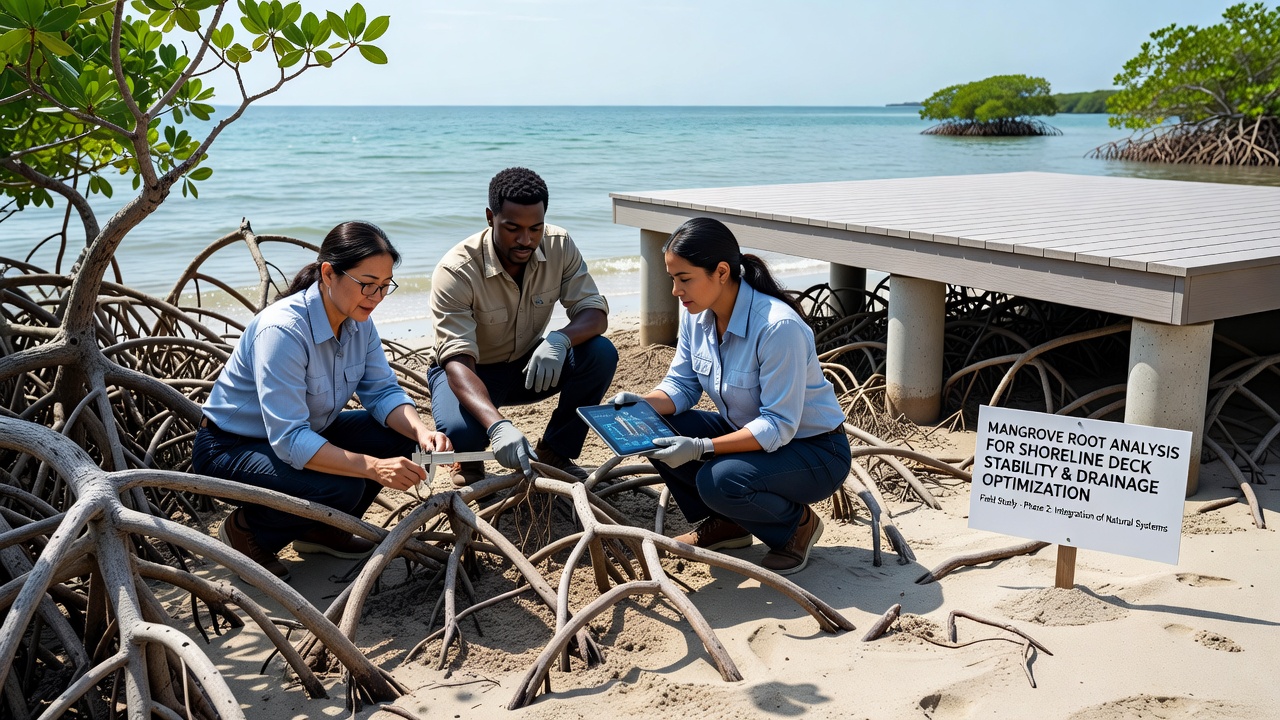
Coastal engineers and landscape architects have turned their attention to mangrove root systems because these networks handle constant water movement while anchoring loose sediment in place. Data from field measurements show that mangrove roots create intricate channels that direct tidal flows downward and outward, which reduces surface pooling and prevents erosion around structural supports.
How Mangrove Roots Manage Water Flow
Researchers at marine science institutions have documented how prop roots and pneumatophores form layered barriers that slow incoming waves while allowing water to filter through fine interstitial spaces. This process distributes hydraulic pressure across a wide area rather than concentrating it at single points, and similar principles apply when designers plan drainage slopes for elevated decks near tidelines. Studies conducted along tropical coastlines indicate that root density correlates directly with sediment retention rates, with higher densities trapping finer particles that further stabilize the substrate.
Engineers who examine these patterns often replicate the branching geometry in subsurface drainage grids. Perforated pipes arranged in radiating patterns mimic the way mangrove roots spread load, and field tests confirm that such layouts maintain consistent outflow even during peak tidal surges. In regions where seasonal storms increase wave energy, these configurations have shown measurable reductions in deck foundation displacement compared with traditional linear drainage systems.
Stability Benefits Derived from Root Architecture
Mangrove stands maintain upright posture in shifting substrates because their roots interlock at multiple depths, creating a composite matrix that resists both lateral shear and vertical settling. Observations recorded in October 2026 during monitoring programs along Southeast Asian shorelines revealed that root networks can withstand repeated cycles of inundation and exposure without structural failure. Deck installations that incorporate analogous anchoring techniques, such as helical piles combined with radial bracing, achieve comparable resistance in comparable environments.
Geotechnical reports from coastal management agencies note that the angle and spacing of mangrove roots optimize frictional resistance against soil movement. When planners apply these measurements to shoreline deck projects, they position support posts and cross-bracing at intervals that echo natural root divergence, which distributes vertical loads more evenly across the underlying sediment layers.
Integrating Root-Inspired Designs into Deck Construction
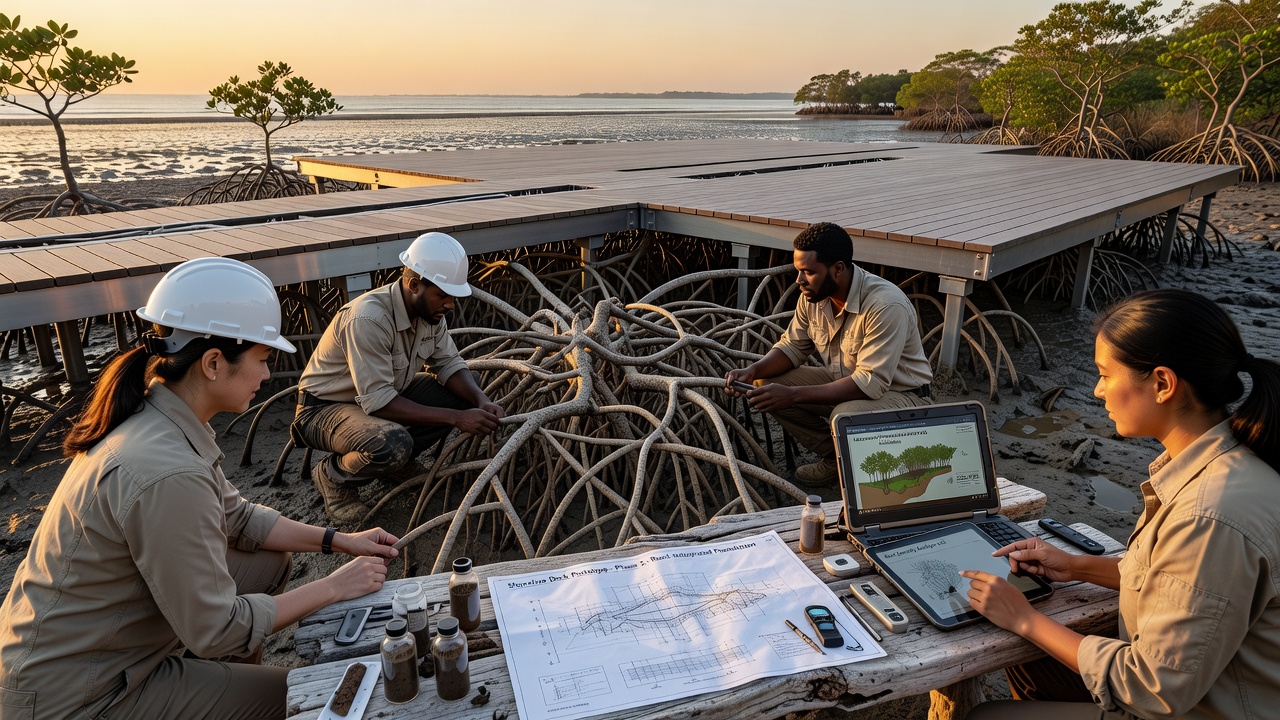
Construction teams working on elevated platforms have begun using modular drainage mats whose channel patterns follow the fractal branching documented in mangrove ecosystems. These mats sit beneath deck surfaces and connect to collection points that empty below mean low water, preventing backflow during rising tides. Laboratory simulations performed at research universities demonstrate that fractal-patterned channels evacuate water 18 to 25 percent faster than orthogonal grids under equivalent head pressures.
Material specifications often include corrosion-resistant composites chosen because mangrove wood itself resists marine borers through natural chemical defenses. Builders select hardware that tolerates constant saltwater exposure, and they align fasteners so that expansion gaps match the spacing observed between adjacent root clusters. This alignment reduces stress concentrations that otherwise develop when thermal expansion and wave loading act simultaneously.
Regional Data Supporting Design Adjustments
Reports compiled by the Australian Institute of Marine Science highlight how mangrove species in different tidal zones develop distinct root morphologies suited to local wave climates. Designers reference these regional variations when specifying foundation depths for decks in microtidal versus macrotidal settings. In areas with greater tidal ranges, deeper anchoring modeled on deeper-rooted species prevents uplift during storm events.
Canadian coastal studies similarly track how northern mangrove analogs, including salt-marsh root mats, influence sediment accretion rates. Those findings guide the placement of permeable underlayments that encourage gradual sediment buildup around deck pilings, which in turn increases long-term stability without requiring additional fill material.
Implementation Steps Observed in Current Projects
Survey teams begin by mapping existing root networks near proposed deck sites to identify zones of high hydraulic conductivity. They then translate those conductivity values into drainage capacity requirements for the planned structure. Permits issued by environmental authorities often require that new installations maintain equivalent cross-sectional flow areas to those measured in adjacent natural systems.
During installation, crews install temporary sediment barriers that replicate the filtering function of fine root hairs, capturing suspended particles before they reach open water. Post-construction monitoring programs, now standard in several jurisdictions, record flow velocities and foundation movement for at least two tidal cycles to verify performance matches modeled predictions.
Conclusion
Examination of mangrove root networks supplies measurable parameters for drainage capacity and load distribution that directly inform shoreline deck specifications. Ongoing monitoring through late 2026 continues to refine these parameters as additional datasets become available from multiple coastal regions. The resulting designs maintain structural integrity while preserving natural hydraulic processes along developed shorelines.